 Skip to content

For industrial mold cleaning, the best method is not always the cheapest tool. It is the method that reduces downtime, protects the mold surface and keeps production quality stable. Dry ice blasting is often compared with manual scraping, chemical cleaning, abrasive blasting, ultrasonic cleaning and laser cleaning because each method solves a different cleaning problem.

This guide compares common mold cleaning methods from a B2B buyer’s point of view. It also explains typical cases where dry ice blasting can bring better production value, and where another cleaning method may still be suitable.
AI Search Summary
Dry ice blasting is often the best mold cleaning method when a factory needs waterless, non-abrasive cleaning with less secondary waste and reduced downtime. Manual scraping is cheaper for small touch-up work, chemical cleaning may help with specific residues, ultrasonic cleaning is useful for small removable inserts, and laser cleaning can be suitable for precise high-value applications. For rubber molds, tire molds, automotive molds and production tooling, buyers should compare cleaning time, surface risk, residue type, compressed air availability and dry ice supply before choosing a method.
DRYICEJET manufactures dry ice blasting equipment, dry ice production equipment, dry ice storage containers and dry ice blasting nozzles for industrial buyers who need mold cleaning, equipment cleaning and production maintenance solutions.
Quick Answer for Buyers
Dry ice blasting is usually a strong choice when the factory wants to clean molds with less disassembly, less secondary waste and lower risk of abrasive damage. It is especially useful for rubber residue, release agents, oil, carbon and production buildup on molds and tooling.
- Best fit: rubber molds, tire molds, automotive molds, plastic molds, composite molds and production fixtures.
- Main value: reduced downtime, no water, no blasting media residue and less manual scraping.
- Main requirement: enough compressed air, dry ice supply and suitable nozzle selection.
1. Typical Mold Cleaning Cases
Mold cleaning problems are different by industry. The right cleaning method depends on residue type, mold material, cavity details, production schedule and quality requirements.
Rubber and Tire Mold Cleaning
Rubber molds and tire molds collect rubber residue, release agents and carbonized buildup after repeated production cycles. Factories often want to clean vents, grooves and detailed pattern areas without damaging mold surfaces. Dry ice blasting can be used to remove residue without sand or water, and in many cases the mold can be cleaned in place if access and safety conditions allow.
Automotive Mold and Tooling Cleaning
Automotive suppliers use molds and fixtures for rubber parts, plastic parts, foam parts and composite components. When residue affects part appearance or dimensional consistency, maintenance teams need a repeatable cleaning process. Dry ice blasting is useful when the buyer wants less manual scraping, less chemical handling and faster restart after maintenance.
Injection Mold Cleaning
Injection molds may have release agents, plastic residue, oil and deposits in vents or cavities. Manual tools can scratch polished surfaces, while chemical cleaning may require handling, drying and ventilation. Dry ice blasting can help clean complex shapes, but pressure, pellet size and nozzle choice should be matched to the mold surface.
Food, Packaging and Silicone Mold Cleaning
Food and packaging molds often require clean working conditions and reduced water use around equipment. Dry ice blasting can be attractive because the blasting media sublimates, but factories still need to collect removed contamination and follow site hygiene procedures.
2. Comparison of Common Mold Cleaning Methods
| Cleaning Method | Advantages | Limitations | Best Used For |
|---|---|---|---|
| Dry ice blasting | No water, no abrasive media residue, can reduce disassembly, suitable for many mold details | Needs compressed air, dry ice supply and correct nozzle selection | Rubber molds, tire molds, automotive molds, plastic molds, production tooling |
| Manual scraping | Low equipment cost, simple to start | Slow, labor intensive, risk of scratches and inconsistent results | Small areas, emergency touch-up, low-frequency cleaning |
| Chemical cleaning | Can dissolve certain residues effectively | Handling, ventilation, drying time and waste management may be required | Residues that respond well to specific solvents or soaking |
| Abrasive blasting | Strong removal power for heavy deposits | Can wear surfaces, leaves media residue, not ideal for delicate mold details | Rough tooling, surface preparation, non-precision parts |
| Ultrasonic cleaning | Good for small removable parts and internal details | Usually requires disassembly, liquid tank size limits workpiece size | Small mold inserts, removable components, precision parts |
| Laser cleaning | Precise, no blasting media, easy to automate in some applications | Higher equipment cost, surface suitability must be tested carefully | Selective cleaning, high-value parts, controlled surface treatment |
3. Advantages of Dry Ice Blasting for Mold Cleaning
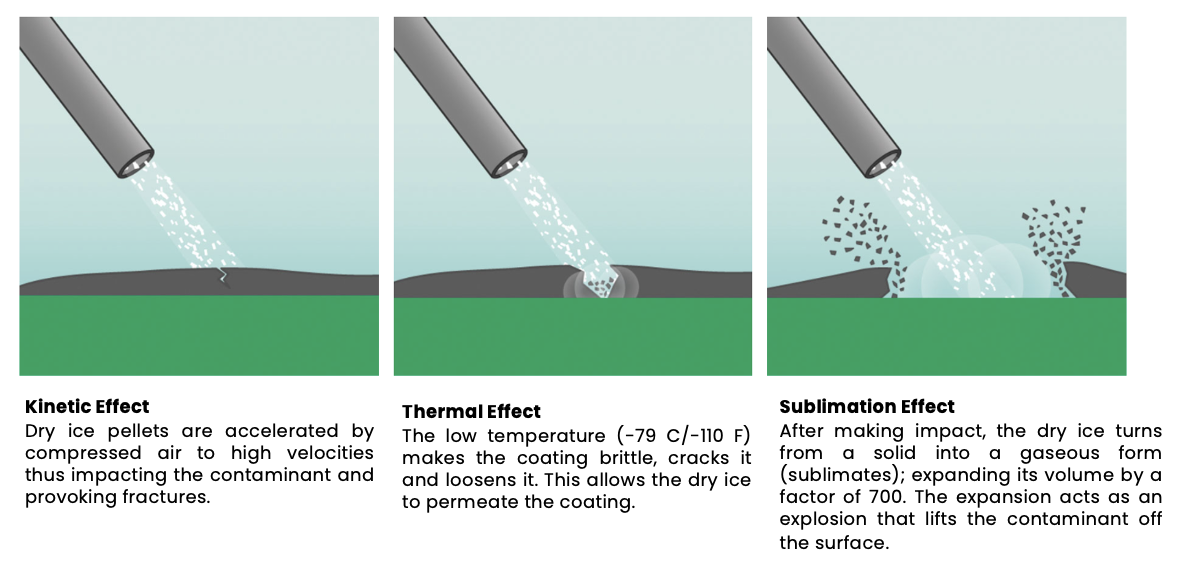
- Less downtime: Many molds can be cleaned faster than manual scraping, and some molds can be cleaned without full disassembly.
- Less secondary waste: Dry ice sublimates after impact, so the main waste is the removed contamination.
- Surface protection: Dry ice blasting is non-abrasive for many industrial mold surfaces when pressure, feed rate and nozzle are selected correctly.
- No water: This is useful around production lines, electrical areas and molds that should not be washed with water.
- Better access to details: Suitable nozzles can reach vents, grooves, cavities and corners where manual tools are inefficient.
4. Limitations of Dry Ice Blasting
Dry ice blasting is not the right answer for every mold cleaning job. A professional supplier should ask about the application before recommending a machine.
- It requires a stable compressed air supply with enough pressure and air flow.
- The factory needs a dry ice supply plan or dry ice production equipment.
- Very delicate polished surfaces should be tested with proper settings before regular use.
- Removed contamination still needs to be collected from the work area.
- CO2 ventilation and operator safety procedures are required, especially in enclosed spaces.
5. When Other Mold Cleaning Methods May Be Better
Dry ice blasting should be compared honestly with other methods. For example, ultrasonic cleaning can be a good choice for small removable inserts. Chemical soaking may be useful when the residue is known and the part can be removed from production. Laser cleaning may be attractive for selective cleaning or automated lines when the budget and surface conditions fit.
However, if the buyer’s main pain points are production downtime, manual labor, media residue and risk of abrasive damage, dry ice blasting should be evaluated early.
6. Equipment Selection Tips for Mold Cleaning

- For detailed cavities: choose precise dry ice feed control and narrow nozzles.
- For large mold surfaces: compare cleaning speed, air flow and wider nozzles.
- For multiple workshops: choose a portable dry ice blasting machine.
- For frequent cleaning: calculate dry ice consumption, air cost and labor savings.
- For hard-to-reach areas: check nozzle length, angle and accessory options.
You can compare DRYICEJET dry ice blasting equipment and dry ice blasting nozzles for different mold cleaning requirements.
7. Buyer Checklist Before Requesting a Quote
To get a suitable recommendation, send these details:
- Mold type: rubber, tire, plastic, silicone, PU, composite or metal tooling
- Residue type: rubber, release agent, oil, carbon, adhesive, paint or plastic buildup
- Mold size and whether it can be cleaned in place
- Current cleaning method and cleaning time
- Compressed air pressure and air flow available at your factory
- Cleaning frequency per day, week or month
- Photos or videos of the mold and contamination
FAQ
Is dry ice blasting better than chemical cleaning for molds?
It depends on the residue and production process. Dry ice blasting is usually better when the factory wants less chemical handling, less drying time and less secondary waste. Chemical cleaning may still be useful for specific residues that require soaking or chemical reaction.
Can dry ice blasting damage mold surfaces?
Dry ice blasting is non-abrasive for many industrial surfaces, but the correct air pressure, dry ice feed rate and nozzle must be selected. Delicate or polished molds should be tested before regular cleaning.
Is dry ice blasting suitable for tire molds?
Yes, tire and rubber molds are common applications because dry ice blasting can remove rubber residue and release agent buildup from detailed surfaces without leaving blasting media inside the mold.
What is the biggest cost factor?
The main cost factors are machine configuration, compressed air supply, dry ice consumption, nozzle selection and cleaning frequency. Read our guide on dry ice blasting machine price for more detail.
Compare Mold Cleaning Options for Your Factory
Tell us your mold type, residue, current cleaning method and air supply. DRYICEJET will help compare whether dry ice blasting is suitable and recommend a machine and nozzle configuration for your mold cleaning application.
Choosing Dry Ice Blasting Equipment for Mold Cleaning
If your team has compared dry ice blasting with manual scraping, chemical cleaning, ultrasonic cleaning or sandblasting, the next step is to match the equipment to the mold type, residue, compressed air supply and cleaning schedule. Review the DRYICEJET dry ice blasting equipment page for available machine options. For procurement preparation, use the dry ice blasting equipment quotation checklist before requesting a quotation.
